
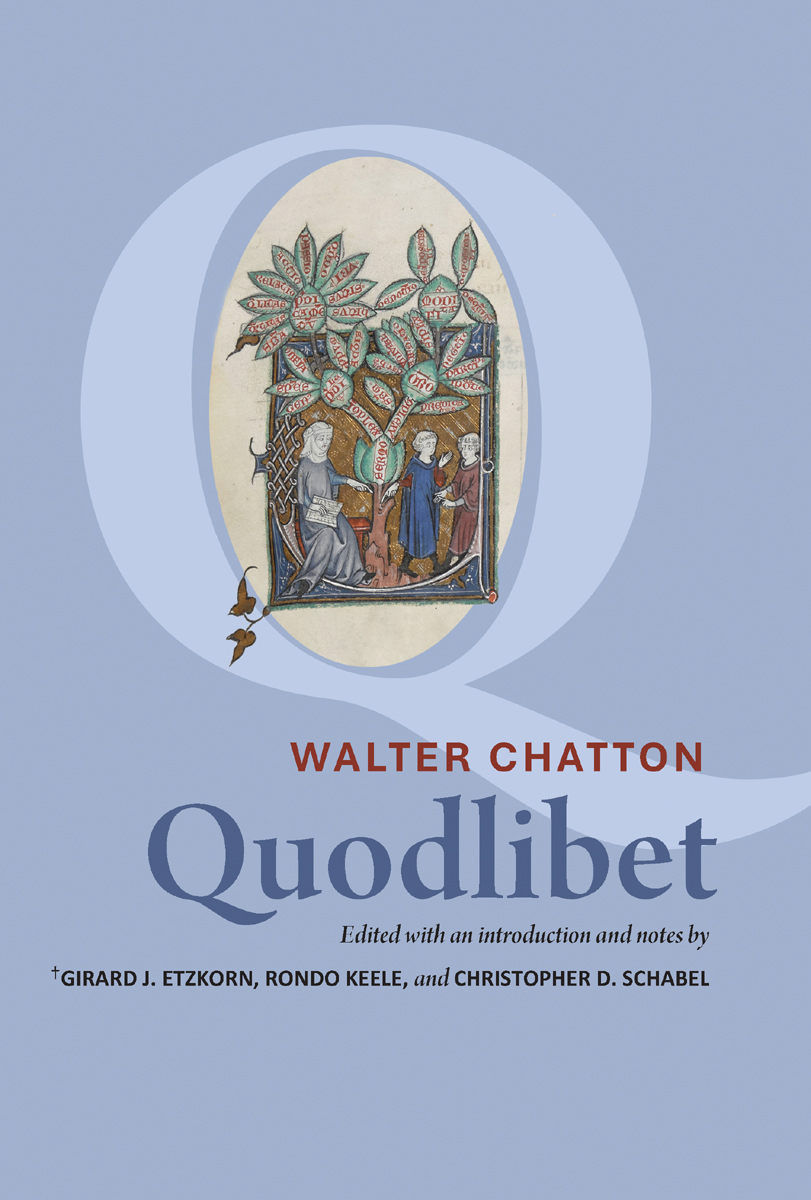
Walter Chatton, Quodlibet
Studies and Texts 245 • lxxviii, 255 pp. • ISBN 978-0-88844-245-1 • Cloth • $125.00
Customers in the US please order through UTP by email (utpbooks@utpress.utoronto.ca) or phone (1-800-565-9523), or through Amazon • Customers in Canada please order through UTP by email, phone, or web • Customers outside North America please order through Brepols Publishers
Walter Chatton (†1343/44) was a central figure in the golden age of the University of Oxford. This edition of his Quodlibet completes the project to provide access to all of his surviving works. A lengthy introduction argues for the authorship, genre, and dating of the Quodlibet, and seizes the occasion to revise Chatton’s biography and describe the philosophical, theological, and historical contexts in which his work is embedded.
Chatton’s influence and significance spring from several distinctive characteristics. First, he was a tenacious critic of fellow Franciscan William of Ockham (†1347), whose philosophy he helped shape in many ways, not least by causing Ockham to abandon an early theory of concepts and eventually to adopt Chatton’s own theory. He was also an able defender of the philosophical theology of John Duns Scotus (†1308), notably on the univocity of being and on the problem of universals. Chatton helped bring Peter Auriol (†1322), another original and prolific Franciscan thinker, to the attention of his contemporaries at Oxford. Finally, Chatton took up certain interesting heterodox philosophical positions, drawing both praise and criticism from such towering figures in English theology as the Franciscan Adam Wodeham (†1358), notably on the problem of future contingents and on his indivisibilist analysis of the continuum.
Chatton’s final position on several of these and many other topics can be found in his magisterial Quodlibet, from a wide-ranging disputation held around 1330, soon after the lectures on the Sentences delivered by Richard FitzRalph (†1360). Chatton composed two other major surviving works, two sets of questions on the Sentences known as the Reportatio and the Lectura, which have been critically edited and published in eight volumes by the Pontifical Institute of Mediaeval Studies.
Editors
Girard J. Etzkorn (1927–2023) was Professor Emeritus of St. Bonaventure University, where he served as a research professor at the Franciscan Institute, and previously was a professor of philosophy at Quincy College and at Southern Illinois University. The editor or co-editor of numerous medieval texts, including works by Ockham, Iohannes Pecham, and Richardus Radulphi, he also collaborated with Joseph C. Wey on editions of Chatton’s Reportatio and Lectura, published by the Pontifical Institute of Mediaeval Studies.
Rondo Keele studied under Paul Vincent Spade at Indiana University, where he earned his doctorate in 2002. He is Professor of Philosophy at the Louisiana Scholars’ College at Northwestern State University, where he teaches courses on various medieval figures and on the history of philosophy generally, but also on logic and classical Latin poetry, especially Martial. His research centers on the intersection between logic, semantic theory, and ontology, especially in the age of Ockham. He has published several studies relating to Walter Chatton, including the entry on Chatton for the Stanford Encyclopedia of Philosophy, and the revised entry co-authored with Jenny Pelletier.
Christopher D. Schabel studied under Katherine Tachau at the University of Iowa, where he earned his doctorate in 1994. After teaching at the University of Cyprus for a quarter of a century, he is now based at the Institut de recherche et d’histoire des textes, Paris. He works on medieval intellectual history and the Latin East, and has edited texts in philosophical theology from the long fourteenth century and diplomata concerning Frankish Greece and Cyprus. With Philipp Nothaft, Mark Gossiaux, Severin Kitanov, Monica Brinzei, and the Cluj-Napoca School of Medieval Philosophy, he has recently published critical editions of works by Hermann Zoest, James of Viterbo, Adam Wodeham, and James of Eltville.
Endorsement
“In 1987, Girard J. Etzkorn convincingly argued that 29 questions found in Paris, BnF, MS lat. 15805 constituted Walter Chatton’s lone Quodlibet. This volume finally makes this text available, completing the series of Chatton’s works published by the Pontifical Institute of Mediaeval Studies. Building on Etzkorn’s preparation, Rondo Keele and Chris Schabel have delivered a top-notch critical edition of a work that ranges over questions on trinitarian theology, Mariology, Christology, as well as on future contingents, moral psychology, and ethics, both normative and applied. An extremely useful historical introduction describes the Quodlibet, details its contents, and revises the dating of Chatton’s career and works. This volume is a major contribution to the study and development of Chatton’s thought and his relation to contemporaries like Peter Auriol, William Ockham, and Adam Wodeham.” — Russell Friedman, Institute of Philosophy, KU Leuven
Ordering
Customers in North America please order through University of Toronto Press Distribution by phone (1-800-565-9523) or by email (utpbooks@utpress.utoronto.ca). If you would like to order through UTP Distribution using another method such as mail or fax, please click here for a full list of contact and ordering methods. PIMS books are also available on Amazon.ca (for Canadian customers) and Amazon.com (for customers in the U.S.).
Customers outside North America please order through Brepols Publishers. PIMS books are available through the Brepols online catalogue.